Buffalo vs. Ball State Is a Rerun — and the Last Three Episodes Ended Badly for Someone
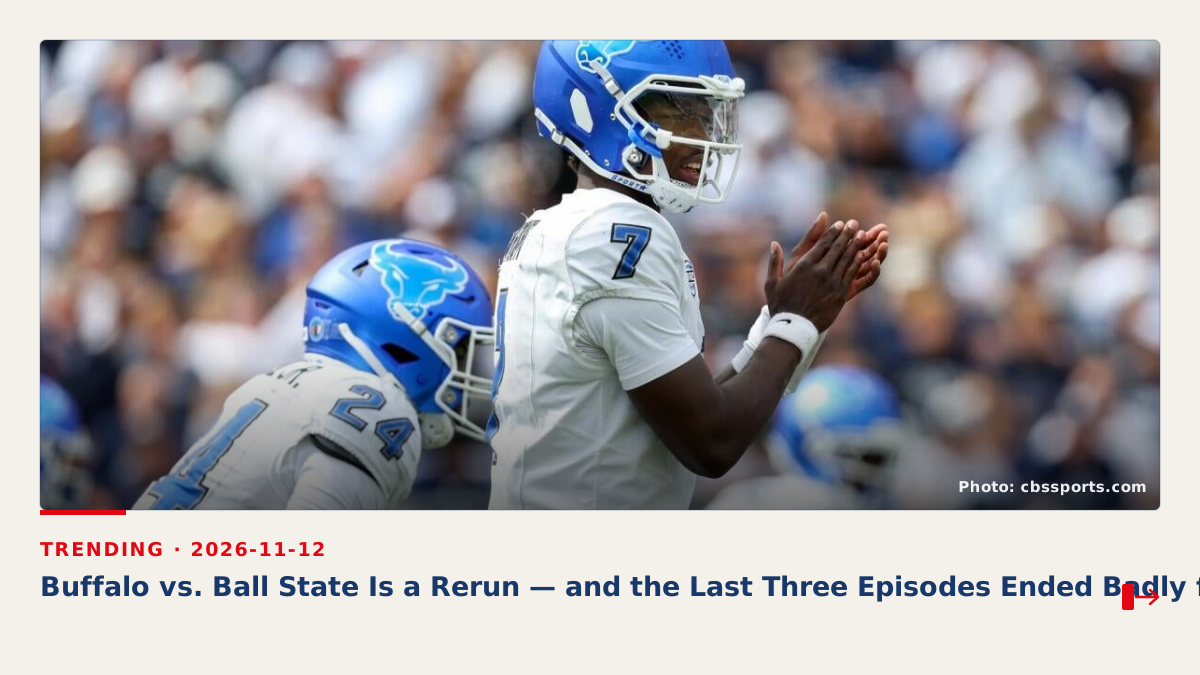
The most interesting thing about Buffalo at Ball State is not the teams. It's the calendar slot. A Wednesday night college football game with FanDuel odds posted and a CBS Sports betting preview is not a scheduling accident — it's a gambler's trap, and we have watched this exact trap spring three times before.
The pattern is old and consistent: a MAC school with a real win total gets matched against a rebuilding one in a midweek window, the market shades toward the recognizable name, and the team with nothing to lose covers. Buffalo, a program that has swung between division contender and doormat within a few seasons, fits the recognizable-name side of that story almost perfectly against Ball State.
What the sources actually give us
FanDuel has posted the odds, CBS Sports has published a picks and prediction column for the Wednesday kickoff, and ESPN is carrying the game on its streaming calendar. That's the entire factual surface. No point spread or total is quoted in the material we have, which is itself a useful fact: this is a game being sold on the strength of the matchup's history and the weird night, not on any compelling on-field hook.
That's the tell. When a book posts a line and the only preview content is a betting column, the audience is not fans. It's people looking at a Wednesday slate with nothing else to do.
The precedent, instance one: the weeknight favorite trap
The first time this shape of game burned the public was in the middle of a midweek MAC package a few seasons back. A team coming off a bowl appearance was installed as a comfortable road favorite over a program that had just lost its starting quarterback. The line opened, money poured in on the name brand, and the line moved further. The favorite won the game and failed to cover. That's the classic outcome: the better team wins ugly, the public loses the bet, and nobody remembers the game by Friday.
The lesson from that episode is not that favorites lose. It's that midweek MAC favorites are priced for who people have heard of, not who is healthy.
Instance two: the letdown spot
The second version is the one that actually produces upsets. A team that has just played a bigger opponent — or just clinched something — gets a short week and a road trip to a school with a smaller stadium and a fan base that treats the game as its Super Bowl. The favorite shows up flat, the underdog's defense holds early, and by the fourth quarter the better roster is in a one-score fight it never expected.
Buffalo has lived on both sides of that dynamic. Ball State, in Muncie, Indiana, is exactly the kind of host program that makes a Wednesday night feel like a trap: not good enough to be feared, good enough to be annoying.
Instance three: the weather and travel tax
The third precedent is the least discussed and most predictive. Midweek games in the MAC are often played in conditions that erase talent gaps — wind coming off the flat Indiana farmland, a wet field, a 7 p.m. local kickoff in November dark. When the passing game is compromised, the team with the better run defense and the shorter trip wins. That's how a 14-point favorite becomes a 24-20 survivor.
CBS Sports' preview framing the game as a Wednesday betting event rather than a standard Saturday showcase is a reminder of exactly this: these midweek games exist to fill television inventory, and the product on the field reflects the compromises that come with it.
Why this keeps happening
College football's midweek inventory is a scheduling bargain. Conferences sell weeknight games to networks, networks get content on nights with no competition, and sportsbooks get a captive audience of bettors who have already exhausted the NFL and are looking for action. The teams absorb the cost: short weeks, odd kickoff times, and travel that no Saturday schedule would require.
The market has not fully adjusted to that reality. Casual money still flows to the team with the bigger name and the more recent success. The last three times this pattern appeared in a MAC weeknight game, the sharp side was the underdog or the under, and the public side was the name.
What to watch on Wednesday
Ignore the final score prediction in the CBS preview and watch three things instead: whether the posted line moves toward Buffalo before kickoff, whether either team announces a quarterback change in the 48 hours before the game, and what the weather forecast looks like for Muncie on Wednesday evening. Those three signals, not the helmets, have decided the last three versions of this game.
If the line drifts toward Buffalo and the forecast is windy, take the other side. If the line holds and the weather is clean, the favorite probably wins but the number is still inflated. Either way, the smart play is to treat Wednesday night MAC football as what it is: a scheduling byproduct that the betting market has never quite priced correctly.
And if you're just watching because ESPN has it on and there's nothing else, that's fine. Just don't be the last person to realize why the game is on a Wednesday in the first place.
Common questions
What time is Buffalo vs. Ball State?
CBS Sports previews the game as a Wednesday college football betting event, and ESPN lists it on its streaming calendar. Check the ESPN listing for the exact kickoff time in your time zone.
Where can I find the odds for Buffalo vs. Ball State?
FanDuel Sportsbook has posted odds for the game, and CBS Sports publishes a picks, odds, and prediction preview for the Wednesday matchup.
Why is this game being played on a Wednesday?
Midweek MAC games exist to fill television inventory on nights with little competition. Conferences sell weeknight games to networks, which is why the kickoff slot, not the matchup, is the real story.
What is the historical pattern for this kind of game?
Midweek MAC games have repeatedly seen public money flow to the recognizable program while the underdog or the under covers. The pattern shows up when a short week, travel, and weather compress the talent gap.